How to Fix Mold on Walls (and Stop It Coming Back)
Diagnose mold vs mildew vs efflorescence, kill it with the right treatment, prime with stain-blocker, repaint with a mold-resistant film. The non-paint fix that actually matters: ventilation.

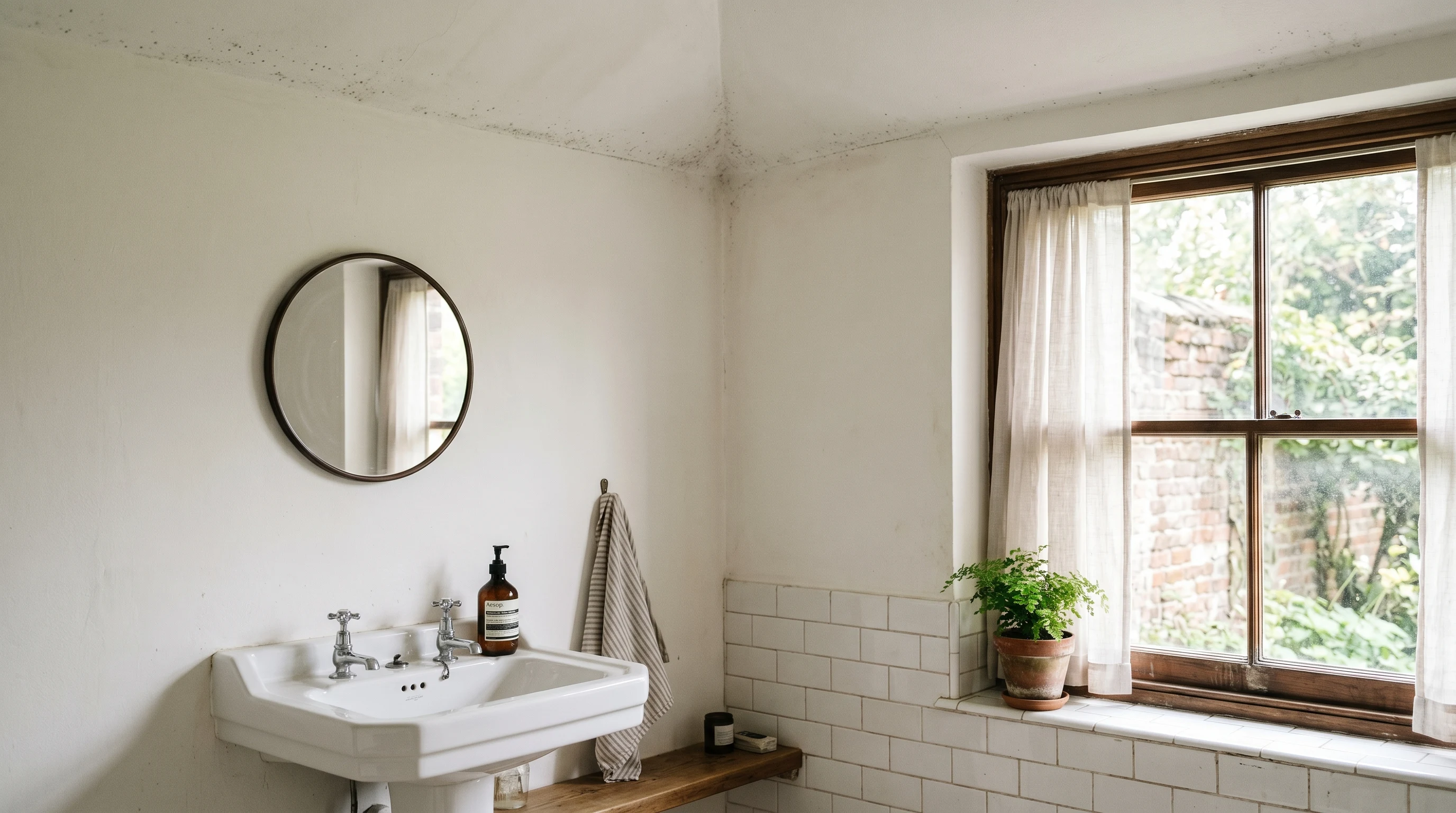
Most paint problems are moisture problems wearing a paint disguise. Mold is the clearest example. Until you fix the moisture source, you can paint over it ten times and it’ll come back ten times.
Does this match what you’re seeing?
Confirm before treating — different problems need different fixes:
- Mildew (surface only): small dark spots, mostly in corners or near showers. Wipes off cleanly with a damp cloth. Comes back if conditions don’t change.
- Black mold (structural): larger dark patches, slimy or fuzzy. Doesn’t wipe clean — leaves shadow even after scrubbing. Often grows behind drywall, around plumbing penetrations, behind furniture against exterior walls.
- Efflorescence (not mold): white powder on brick, masonry, or concrete. Mineral salts pushed out by moisture. Treated differently — see exterior brick guide →.
- Cosmetic dark spotting (not mold): dust accumulation in textured corners, soap scum, or pencil marks. Wipes clean with regular cleaner. Don’t treat as mold.
How serious is this?
If the affected area is larger than 10 square feet, EPA recommends professional remediation — the spores released during DIY removal can be harmful. If it keeps coming back after treatment, the moisture source is still active (leaky pipe, vapor migration, poor ventilation). Find that BEFORE you paint again.
Why this is happening (root cause)
Mold needs three things: moisture, organic food (paint, drywall paper, dust), and 65–85°F. Take any one away and growth stops.
In bathrooms, moisture comes from showers and condenses on cold surfaces — the wall behind the toilet, the ceiling above the shower, anywhere ventilation is poor. In basements, it’s vapor migration through concrete walls. Behind furniture against exterior walls, it’s the dew point — warm humid interior air condensing on a cold wall surface.
Killing the mold and repainting fixes the visible problem. It doesn’t fix the moisture problem. If you don’t change ventilation, gutter direction, or vapor barriers, you’ll be back here in a year.
The fix
Step 1 — Contain
Open a window. Run an exhaust fan if one’s nearby. Wear an N95 mask, eye protection, and gloves. If the area is >10 sq ft, stop here and call a pro.
Step 2 — Treat
Spray the affected area with Concrobium Mold Control (no rinse needed — it physically crushes spores as it dries) or RMR-86 Instant Mold Stain Remover (faster but stronger fumes — ventilate well). Let dwell 10 minutes.
If you prefer a household solution: 1 part bleach to 10 parts water in a spray bottle. Spray, dwell 10 minutes, rinse with clean water. Never mix bleach with vinegar, ammonia, or hydrogen peroxide — produces toxic chlorine gas.
Step 3 — Dry completely
Mold needs moisture. Removing moisture is half the cure. Run a dehumidifier or fan for 24–48 hours until the wall is bone-dry to the touch. Don’t rush this step.
Step 4 — Prime with stain blocker
Zinsser Mold Killing Primer (water-based, contains biocide) OR Zinsser BIN (shellac, blocks the dark stain ghost). One coat. Let dry per label.
Step 5 — Repaint with a mold-resistant film
Zinsser Perma-White is the standard — formulated specifically for kitchens, bathrooms, basements. Two coats. Self-priming over the stain-block layer. Five-year mold-resistance warranty.
For round-up alternatives, see best mold-resistant paint →.
Safety & chemical interactions
Never mix bleach with vinegar, ammonia, or hydrogen peroxide. Produces toxic gas. Ventilate well during all wet steps. Mask up — even Concrobium kicks dust as you work.
Prevention (the part that actually matters)
- Bathrooms: run the exhaust fan during AND for 20 minutes after every shower. Replace the fan if it’s underpowered (target: 1 CFM per square foot of bathroom).
- Basements: dehumidifier set to 50%. Permanent. Drain to a sump or floor drain so you don’t have to empty it.
- Behind furniture on exterior walls: pull the furniture 2 inches off the wall to allow air circulation.
- Gutters and downspouts: if exterior water is finding its way through the foundation, no paint will save you. Fix the gutter direction first.
Treatment products — what we use
Stocked at any home center, but the choice depends on substrate:
| Product | Form | Best for | Notes |
|---|---|---|---|
| Concrobium Mold Control | Spray, no rinse | Drywall, painted surfaces | EPA-registered, no harsh fumes, works as it dries |
| RMR-86 Instant Mold Stain Remover | Spray | Tile, grout, fiberglass | Fastest stain removal; strong fumes, ventilate |
| Zinsser Mold Killing Primer | Brush/roll | Drywall before repaint | Combines stain block + biocide in one step |
| Zinsser BIN | Brush/roll | Stained drywall, ceilings | Shellac-based, blocks the dark ghost permanently |
| 1:10 bleach + water | Spray, rinse | Tile, non-porous | Cheap; wipe-down only — doesn’t penetrate substrate |
We avoid recommending hydrogen peroxide or vinegar as standalone treatments. They reduce surface mold visibly but don’t deactivate spores deep in porous substrates the way EPA-registered biocides do.
Why mold returns (the cycle to break)
The “I treated and repainted and it came back” pattern is so common that the EPA’s mold guidance opens with it. The cycle:
- Mold appears because a surface stays damp (condensation, leak, vapor).
- You scrub, treat, prime, repaint. Visible problem solved for now.
- The moisture source you didn’t fix delivers more water to the same surface.
- Spores trapped in nearby drywall (or new spores from indoor air) re-colonize at the moisture interface.
- Six to eighteen months later, it’s back.
The break point is step 3, not step 4. Mold-resistant paint slows step 4; nothing fixes step 3 except moisture control. The order of operations: find the moisture source first, fix it, then treat and repaint. If you can’t find the moisture source — vent fan running but inadequate, no obvious leak — measure with a hygrometer for two weeks before painting. Indoor relative humidity above 60% during normal use is the moisture source.
Climate, ventilation, and the hidden HVAC factor
Where you live changes the calculus:
- Coastal humid climates (Gulf, Southeast, Pacific NW): indoor RH naturally tracks outdoor — you fight 70%+ summer humidity unless the AC dehumidifies aggressively. A whole-house dehumidifier or a properly-sized AC is the actual fix. Mold-resistant paint helps but doesn’t solve.
- Cold-winter climates (Midwest, NE): mold appears on cold surfaces in winter — exterior corner walls, behind furniture against an outside wall, top of basement walls. The “moisture source” is interior humid air condensing on cold surfaces. Insulation upgrades + interior RH below 40% in winter solve it.
- Arid climates (Southwest): mold on bathroom walls only, almost always a ventilation problem. Run the fan longer.
If your HVAC’s evaporator coil or supply ducts are mold-positive — musty smell when AC kicks on, dark spotting visible at vent registers — that’s an HVAC remediation problem, not a paint problem. Paint won’t help; you need a coil clean and possibly duct cleaning.
When mold-resistant paint isn’t enough
Three scenarios where you should not paint over the problem at all:
- Visible water damage to drywall or framing. Soft, sagging, or stained drywall has absorbed water deep into the gypsum. Paint won’t seal it, and the substrate is feeding the mold. Cut out the affected drywall, dry the framing to <15% MC, and replace.
- Mold growing through fresh paint within 90 days. The biocide in mold-resistant paint should buffer 5–7 years; through-growth at 90 days means there are far more spores in the substrate than the topcoat can suppress. Strip back to substrate and re-treat with a stronger biocide-and-encapsulation system.
- Black mold (Stachybotrys) suspected. Dark, slimy texture, often growing behind drywall around plumbing leaks. EPA recommends professional remediation. Don’t disturb it without containment.
When to call a pro
- Affected area >10 sq ft (EPA threshold)
- Visible water damage to drywall or framing
- Recurring growth after two treatment cycles (moisture source is unfixed)
- Suspected black mold (Stachybotrys — dark, slimy, often behind drywall)
- Pre-1978 home with peeling paint near the mold (test for lead first — RRP rule)
- HVAC mold growth (DIY treatment will spread it)
- Anyone in the home with severe asthma, immune compromise, or pregnancy — let a remediator handle it
Related
Frequently asked questions
Mold or mildew — does the difference matter?+
Can I just paint over mold?+
Does mold-resistant paint actually work?+
When should I call a pro?+
- Best mold-resistant paint round-up
- How to paint exterior brick (efflorescence chapter)
- Sheen guide (satin for bathrooms)