What Is LRV? Light Reflectance Value, Explained
LRV is the number that tells you how a paint color will actually behave once light hits it. Here's how to read it and why it matters more than the chip.

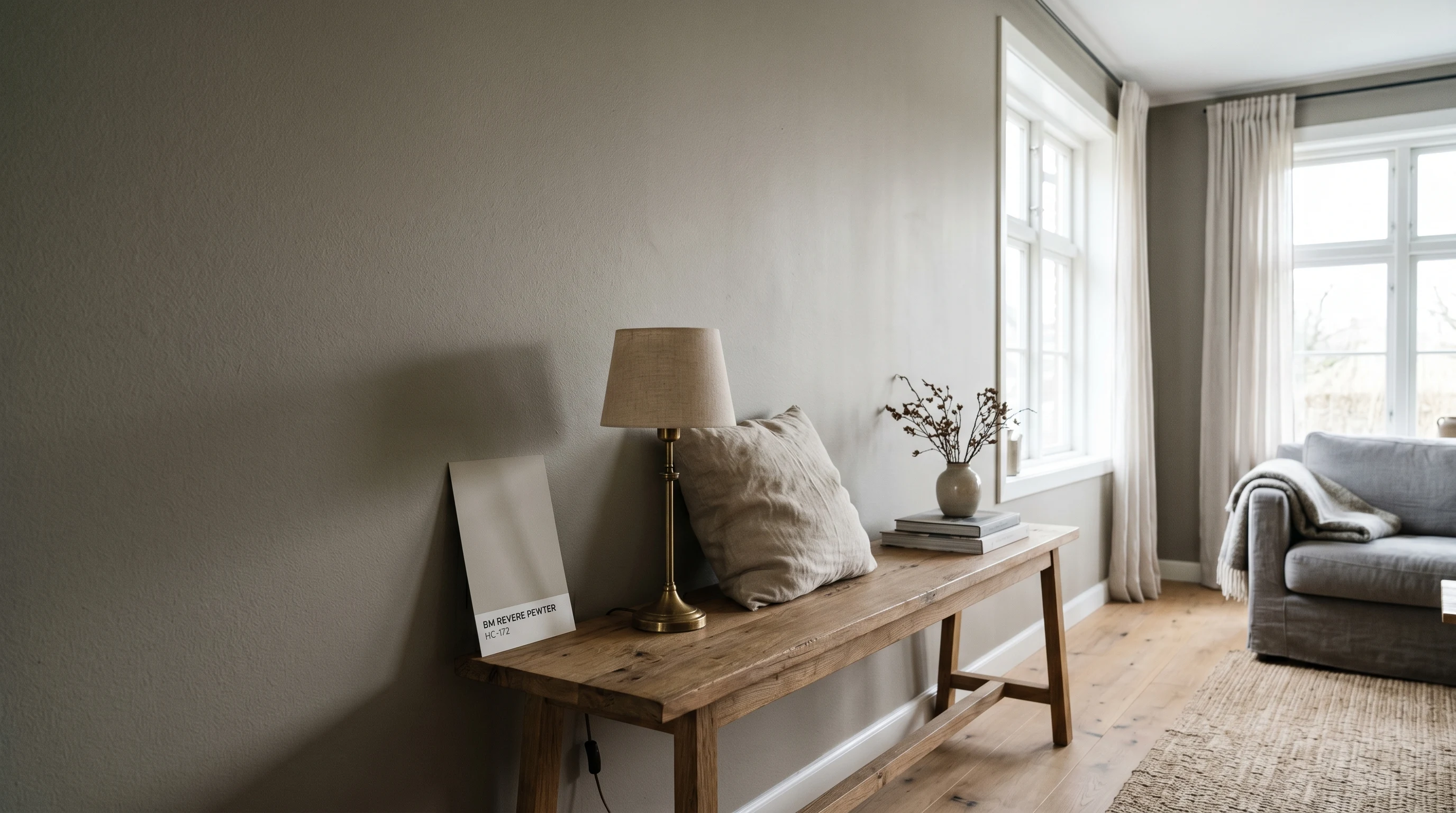
A north-facing living room I worked on last spring had been painted what the homeowner swore was “warm cream.” On the chip, under store fluorescents, it was. On the wall at 10am, in cool window light, it read grey-green and tired. The paint hadn’t changed. The light had. And the number that would have warned us, printed in tiny type on the back of the chip, was the LRV.
LRV stands for Light Reflectance Value, a single number from 0 to 100 that tells you what percentage of visible light a dried paint film bounces back into the room. Real paint never hits either extreme. The whitest whites top out around LRV 94. The blackest blacks bottom out near LRV 5.
Once you start reading LRV, you stop being surprised by what colors do in real rooms.
What LRV actually measures
LRV is calculated from the color’s relative luminance, weighting red, green, and blue by how sensitive the eye is to each (green dominates). That’s why a deep forest green reads lighter, and carries a higher LRV, than a navy of the same apparent saturation.
LRV is not darkness and it isn’t saturation. A vivid pumpkin orange and a quiet beige can share an LRV around 55. The orange feels louder, the beige calmer. They bounce roughly the same light back regardless.
LRV by range — what each band feels like
| LRV range | Reads as | Typical use |
|---|---|---|
| 85–94 | True white | Trim, ceilings, gallery walls, north-facing rooms that need lift |
| 75–85 | Soft white / off-white | Whole-house neutrals, bright but not clinical |
| 50–75 | Light to mid-tone | Greiges, soft sages, warm taupes; workhorse wall colors |
| 25–50 | Mid-tone | Confident colors that hold their own against trim and floor |
| 10–25 | Deep | Dining rooms, libraries, powder rooms, moody bedrooms |
| 0–10 | Near-black | Accent walls, front doors, statement furniture |
The bands aren’t rigid. An LRV 78 white in a south-facing room can read brighter than an LRV 84 white in a north-facing one. They’re a useful shorthand. When a designer says “I’d go a touch lighter,” they usually mean five to eight LRV points.
Why LRV matters more than the chip
A chip is a 2-inch square viewed under store lighting that has nothing to do with your house. It tells you the color exists. It does not tell you how the color will behave.
LRV does. A wall at LRV 72 feels airy and reflective; the same hue at LRV 22 feels held and absorbed. I’ve watched clients agonize over two greiges that share an undertone, when the real difference they’re feeling is six LRV points. Sort your shortlist by LRV before you sort it by color.
Two colors at the same LRV reflect the same light but won’t feel the same. A greige and a sage at LRV 50 share a brightness; the sage drapes the room in color, the greige stays quiet behind whatever you put in front of it. LRV is the volume knob. Hue is the song.
How light direction shifts the reading
In a north-facing room, daylight is soft, cool, and indirect. LRV reads roughly 5–10 points lower than the chip suggests, and colors look heavier and cooler. A “soft white” at LRV 80 can go greige here. Push your shortlist 5–10 points higher than you think you need.
South-facing rooms run the opposite way. Strong, direct sun for most of the day means LRV reads slightly higher and noticeably warmer, so you can drop into the 50s and 60s without the room going dim. Watch the inverse problem in summer: direct sun on a low-LRV wall can make the color feel hot and visually loud.
A room with big windows and an LRV 18 wall reads as drama. The same wall in a hallway with one weak overhead reads as a cave. The number alone doesn’t predict the mood. The number plus the light does.
Common mistakes
- Shopping LRV in isolation. LRV 65 in a warm putty and LRV 65 in a cool dove grey reflect the same light, but they sit very differently against your floor. Use LRV to narrow the shortlist, then choose the undertone.
- Treating LRV as a darkness rating. A high-chroma teal can have a mid-range LRV that sounds “light” on paper but reads vivid on the wall. LRV is brightness, not saturation.
- Ignoring the trim gap. A wall and trim within 5 LRV points of each other make the architecture disappear. For crisp millwork, aim for 15–20 points of separation.
- Forgetting the ceiling. A ceiling at LRV 90 over walls at LRV 30 flattens the room. Either bring the ceiling within 20 points of the walls or commit to the contrast.
Working against your fixed finishes
Walls are repaintable. Floors, counters, and trim are not, and they’re already setting an LRV before you choose a color.
A pale oak floor sits around LRV 50–55; stained walnut reads closer to LRV 12. Most rooms feel resolved when the wall LRV is within 20 points of the floor in either direction. Standard trim white lands around LRV 85–90, so a wall below LRV 30 frames the architecture sharply, while a wall in the 50–70 range lets the trim hold the edges quietly. In kitchens, upper cabinets at LRV 80+ keep the room feeling open even with rich lower cabinets in the 20s, because the eye reads the brighter band first.
Using LRV when you shop
Pull three to five chips you like. Flip them over and write the LRVs on the front in pencil. Stand them against your floor, your trim, and your largest piece of furniture, at the time of day you actually use the room. The chip closest to the LRV you want, within 3–5 points, is the one to sample at full size. Paint a 2x2 board, lean it against the wall, and look at it morning, afternoon, and lamp-lit. The number got you to the shortlist. The board confirms the choice.
For a shortlist by family and undertone, browse our color hub. For high-LRV decisions, the whites collection is sorted by LRV. For low-LRV drama, blacks and charcoals shows what each near-zero color does next to wood and brass.
Related
Frequently asked questions
What is a good LRV for a living room?+
Is a higher LRV always better?+
Where do I find a paint's LRV?+
Does LRV change with sheen?+
What's the lowest LRV I can use without the room feeling like a cave?+
- Browse colors by LRV and undertone
- Whites — high-LRV color family
- Grays and greiges — the mid-LRV workhorses
- Paint sheen guide
- Color matcher — find an LRV match