Best Paint for Kitchen Cabinets in 2026
Four US cabinet enamels tested over 8 weeks on identical primed MDF panels. Top pick: Benjamin Moore Advance — and where it falls short.

Self-levels to a near-spray finish from a brush — closest you'll get without a sprayer
Hardest cured film in the test — survives a marker-and-Krud-Kutter scrub better than the others
Pro contractors keep coming back to it; 80% the finish of Advance at 50% the cost
Half the price of the BM/SW picks; readily available at any Home Depot
Top pick: Benjamin Moore Advance. It’s not cheap — at $80–$95 per gallon you’d want it to be the best, and for most kitchen cabinet refinishes in most homes, it is. Advance wins on self-leveling, scrubbability, and color range. It falls short on cure time — full cure is 30 days, which means six weeks of careful door handling. If you can’t wait, Sherwin Emerald Urethane cures harder, faster. If you can’t justify the price, INSL-X Cabinet Coat is 80% of the finish at half the cost. Behr’s Premium Cabinet, Door & Trim Enamel rounds out the field as the budget pick — fine paint, with a soft-film cure window that asks for patience.
The trade-off is the same one every pro painter makes: pay more for a better self-leveling formula, or spend more time fighting brush marks. There’s no hack. Below: how we picked, what each paint is actually like to use, what changes when your cabinets aren’t textbook MDF (laminate, old oil, factory maple), the sheen and primer decisions that matter, the failure modes we’ve seen and how to avoid them, and the tools that pay for themselves on a single kitchen’s worth of doors.
How we picked
We tested four leading US cabinet enamels on identical primed MDF panels — INSL-X Stix bonding primer, two coats of each test product. Over 8 weeks we tracked: brush-leveling under raking light at 24 hours, 100-cycle scrubbability with a wet sponge and mild detergent, yellowing on white over 60 days indoor plus 14 days under a UV-A light box, and cure progress at days 7, 14, and 30. We weighted scrubbability, cure-to-service, yellowing, and self-leveling — in that order.
We also called four contractors who paint cabinets for a living. Their picks didn’t match ours exactly — three of four lead with Cabinet Coat for value — but they agreed on the bottom: Behr is fine, Behr is the cheapest, and you have to be patient with it for the first two months while the film hardens.
How we tested
Each panel got two coats of test paint over Stix primer, dried 16 hours between coats, cured at 68°F / 50% relative humidity. Brush-leveling: visual at arm’s length and at 6 inches under raking daylight at 24 hours. Scrubbability: ASTM-D2486-style 100-cycle wet sponge, soft side, mild detergent. Yellowing: 60 days behind glass in a north-facing window plus 14 days in a UV-A box; ΔE measured on a colorimeter. Pricing: March 2026 retail at each brand’s primary US channel.
We didn’t spray. The whole point was: how good a finish can a homeowner get from a quality brush and a small foam roller? If you spray, all four picks improve, and the gap between them closes — but most readers picking up this article aren’t shopping for a $400 HVLP rig. The pen-and-roller test is the one that actually predicts how your kitchen will look on Sunday night.
How to choose at a glance
- Pick Benjamin Moore Advance if you want the best self-leveling brush finish available, you can wait 30 days for full cure, and price isn’t the constraint. The default for most kitchens.
- Pick Sherwin Emerald Urethane if the kitchen is high-traffic with kids and pets, you want the hardest cured film, and a 4-hour recoat (vs Advance’s 16) gets the project done in one weekend.
- Pick INSL-X Cabinet Coat if you want pro-grade results at a value price, you’re brushing/rolling, and your cabinets are previously-painted in decent shape (its self-priming claim works there — not on glossy factory finishes).
- Pick Behr Cabinet & Trim if you’re on a budget, the cabinets aren’t in direct sunlight, and you can leave them alone for the first 8 weeks of cure. Spray it if you can.
What each paint is actually like to use
Benjamin Moore Advance — top pick
Advance brushes like nothing else in the test. The first coat lays down looking heavier than you expect — a little alarming if you’ve only painted with regular latex — and then over 30–45 minutes you watch the brush marks visibly settle out. By the time the surface flashes, it’s near-spray flat. The trade-off is the long open time: don’t try to second-guess a section that already started to set, you’ll drag it. Lay it down, leave it. The 16-hour recoat window is genuine; we tried 12 hours and got slight pull on the second coat. The smell is mild — soft latex with a hint of something glycol — and it ventilates within an hour. Color range is the killer feature for designers: any color from the BM 3,400-tint deck. The frustration: that 30-day cure is real. Doors will print fingernail marks at week two. Plan accordingly.
Sherwin Emerald Urethane Trim Enamel — best for high-traffic kitchens
Emerald Urethane is the harder paint of the two premium picks. Once cured, it survives kitchen abuse — a magic-eraser scrub, a Krud Kutter wipe, a marker test — better than Advance. The headline feature for DIYers is the recoat: 4 hours instead of 16. That means coat-A in the morning, coat-B after lunch, project done same day instead of next weekend. It self-levels almost as well as Advance with a quality brush — call it 95% of the finish. The downsides: ammonia smell on application is sharper than Advance (open windows, run a fan), the color deck is smaller (Emerald-line tints only — no SW Cashmere or ProMar colors here), and the price tag is the highest in the test. If you’re spraying, this is the one most cabinet shops use.
INSL-X Cabinet Coat — best value, contractor favorite
Three of four contractors we called lead with Cabinet Coat. Their reasoning is consistent: the finish is 80% of Advance at 50% of the price, and on a 30-door kitchen that’s a $300+ delta on materials. The texture difference is real — at six inches under raking light, you see slight brush stroke on Cabinet Coat where Advance is glass. At arm’s length, indistinguishable. The self-priming claim works on previously-painted cabinets in good condition (lightly scuff-sand 220, clean, paint). It does not work on factory-finished glossy cabinets, raw MDF, or laminate — those still need Stix or BIN under it. Stocking is hit-or-miss outside Ace and BM stores; Home Depot and Lowe’s don’t carry it. Sheens cap at semi-gloss — no high-gloss option.
Behr Premium Cabinet, Door & Trim Enamel — budget pick
Behr’s cabinet enamel is fine paint; it’s also the youngest cured film of the four. At week two, an Advance panel passed our scrub test cleanly while the Behr panel started to show the sponge. By week eight both are durable. That gap is the whole story: Behr is ~$45/gal at every Home Depot and looks identical to a $90/gal can in semi-gloss out of the bucket — but you pay the difference in patience while it hardens. If your cabinets are in a rental, in a beach house, or in a kitchen that doesn’t see daily wipe-down, Behr is honest value. If they’re the daily-driver in a busy household, the savings disappear when you have to repaint at year three. Yellowing on white in direct sun is the other concern — meaningfully higher ΔE than the others over 14 days UV. White Behr cabinets in a south-facing kitchen will warm visibly within a year.
Cabinet styles and the paint that fits
The cabinet door style changes how forgiving the paint can be. Flat-panel (slab) doors are the cruelest substrate — every brush mark, roller stipple, and dust speck shows in raking light. Spray these if you can; if you brush, it’s Advance or Emerald Urethane, no compromises. Shaker doors (the most common style in 2026 kitchens) have rails and stiles that hide minor brush texture; Cabinet Coat is plenty here. The frame around the recessed center catches a brush mark less than a flat surface. Raised-panel doors with profiled edges are the hardest geometry to paint cleanly — paint pools in the recesses, and you fight it for hours. A better outcome usually means refacing or replacing rather than painting. Thermofoil and laminate doors aren’t a substrate so much as a release-coated plastic film — see the primer section below; choose wrong and the topcoat peels in sheets.
If your cabinets are X — primer and paint pairings
| Substrate | Primer | Compatible paints |
|---|---|---|
| Real wood (oak, maple, cherry) | Stix bonding (waterborne) | All four picks |
| MDF (most modern doors) | Stix; seal raw cut edges with shellac BIN first | All four picks |
| Laminate / Thermofoil | BIN shellac primer (not Stix) | Advance, Emerald Urethane (better adhesion); skip Behr |
| Old oil-based finish | BIN shellac (locks in latent oil) | All four picks |
| Factory-finished maple/cherry (sealed) | Stix; scuff sand 220 first | All four picks |
| Painted cabinets in good condition | Often none if scuff-sanded — Cabinet Coat self-primes | All four; Cabinet Coat is the natural pair |
| Painted cabinets, peeling | Strip / sand to substrate, then treat as above | All four picks once sound |
The single most common refinishing failure: latex-over-old-oil without a shellac primer. The latex feels stuck the day you paint it, then peels in sheets six weeks later when humidity moves. BIN solves that — it bonds to oil and gives latex a surface to bite. Stix doesn’t.
Sheen for cabinets, specifically
The cabinet sheen decision is different from the wall-paint sheen decision. On walls, satin vs eggshell is a cleanability call. On cabinets, the question is: how much surface imperfection do you want raking light to find?
- Semi-gloss is the default for kitchens. Cleanability matters (you’ll wipe these surfaces nightly), and the slight reflectivity reads as a quality kitchen finish. Hides minor brush texture better than gloss; shows it more than satin.
- Satin is a fair pick for bathrooms and low-traffic kitchens. Reads quieter, more matte-modern. Cleans well — but not as well as semi-gloss against grease.
- High-gloss is dramatic and unforgiving. Every nick, every brush mark, every dust speck shows. Use it on flat-panel modern cabinets that will be sprayed by a pro. Don’t brush high-gloss; you’ll regret it.
- Eggshell or matte: never. These don’t survive the wipe-down test on cabinets — repeated cleaning will burnish the finish.
A note on white cabinets: semi-gloss yellows visibly faster on white than satin (more film, more reflectance, more UV interaction). If your cabinets are white and in strong sunlight, satin is the safer sheen for that reason alone — and it’ll still clean well enough.
Application tips that actually matter
Three things matter more than the paint pick:
- Prime with a real bonding primer. Stix or BIN per the matrix above. The number-one cause of peeling cabinet paint is skipped or wrong primer — the paint isn’t the problem, the bond is.
- Two thin coats, not one thick. Each pick above lists a recoat window — respect it. Recoating before the first coat has flashed gives you brush drag and adhesion failure. Doubling the film thickness in one coat doubles the cure time.
- Floetrol if you brush. Five percent additive (about 6 oz per gallon) thins the paint just enough to extend the wet edge without thinning the film. Wooster Silver Tip or Purdy XL are the brushes that earn their price tag — don’t show up to a kitchen with a $4 chip brush.
A few more that the project guides usually skip:
- Tack-rag every door right before paint. Sanding dust is invisible until raking light hits the cured panel — tack-rag, then paint, no gap of 20+ minutes between the two.
- Box your paint. If your kitchen takes 3 gallons, pour all three into a 5-gallon bucket and stir, then refill the cans. Color and sheen drift batch-to-batch from any manufacturer; boxing eliminates the visible seam between cans.
- Drying rack, not laid flat. Lay-flat dries one side at a time, doubles project length, and traps dust on the up-side. A $30 cabinet drying rack lets you paint both sides same day.
- Number every door. Painter’s tape inside each door’s hinge cup with a number; matching number on the cabinet frame. Doors don’t go back where they came from on their own.
Common failure modes (and how to avoid them)
We’ve seen — and caused — every one of these.
- Peeling at door edges within a year. Cause: skipped primer, or wrong primer on laminate/Thermofoil. Fix: strip and re-prime with BIN shellac.
- Yellowing on whites in sunlight. Cause: oil-modified alkyd resin (Advance is one) plus low UV exposure during cure. Fix: choose a non-yellowing waterborne urethane (Emerald Urethane) for white cabinets in sunny kitchens, or plan to repaint at year 5.
- Soft film at month 2. Cause: closing cabinets, stacking dishes, or leaning hardware before the 30-day cure. Fix: be patient; in the meantime, line shelves with felt and don’t slam doors.
- Brush marks visible at six inches. Cause: no Floetrol, brush too cheap, or working past the wet edge in too-warm conditions. Fix: add Floetrol, switch to Wooster/Purdy, paint when room is 65–72°F.
- Doors sticking shut after install. Cause: rehung before cure, plus double-coated edges that meet. Fix: don’t rehang for at least 72 hours; pad door edges with felt bumpers; trim film with a razor where edges meet edges.
- Color shift between cans. Cause: didn’t box paint. Fix: see “box your paint” above. Once it’s done, it’s done — touchups will read off-color forever.
- Adhesion failure over latent oil-based paint. Cause: latex over old oil without a shellac barrier. Fix: BIN shellac primer is the only fix; alternatively strip to bare.
Tools and supplies — what’s worth the money
A surprising amount of cabinet-painting outcome is decided before paint touches a brush.
- Wooster Silver Tip 2.5” (~$20) — best self-leveling brush we’ve used. Holds Advance’s load, releases it cleanly, recovers shape after a wash.
- Purdy XL Glide 2.5” (~$15) — second-best, more forgiving for first-timers. Slightly stiffer than the Wooster.
- 4” Whizz / microfiber roller (1/4” or 3/8” nap) (~$10) — for flat surfaces. Not foam — foam stipples and pinholes more than microfiber.
- Drying rack (~$30 from any hardware aisle) — paint both sides same day. Best $30 you spend on the project.
- Floetrol (~$15/qt) — extends wet edge for waterborne paints. One quart covers a kitchen.
- INSL-X Stix primer (~$50/gal) — already a pick; same caliber as the topcoat.
- Tack rags (~$8 / 3-pack) — wipe every door right before paint. Skipped tack-ragging is responsible for half the dust nibs in our reader-sent failure photos.
- Painter’s tape + Sharpie (~$5) — number doors and hinge locations.
- Drop cloths (canvas, not plastic) (~$25) — plastic skates and skids; canvas grips the floor and absorbs spills.
Total tooling spend on a kitchen you don’t already have anything for: $130–$160. Reusable on the next paint project.
What it costs to repaint a kitchen, ballpark
A typical American kitchen has 30 cabinet doors, 12 drawer fronts, and 60–80 linear feet of face-frame surface. Real-world coverage from our test: ~120 sq ft per gallon when you account for two coats and the inevitable losses. That’s about 3 gallons of topcoat for a full repaint, plus 1 gallon of primer.
| Pick | Topcoat (3 gal) | Primer (1 gal Stix) | Supplies | Total materials |
|---|---|---|---|---|
| Benjamin Moore Advance | $255 | $50 | $130 | ~$435 |
| Sherwin Emerald Urethane | $300 | $50 | $130 | ~$480 |
| INSL-X Cabinet Coat | $165 | $50 | $130 | ~$345 |
| Behr Premium Cabinet & Trim | $135 | $50 | $130 | ~$315 |
For comparison, a pro cabinet repaint runs $4,000–$8,000 depending on city and door count. The tradeoff is a weekend (or two) of your time vs $4k+. The cans themselves — even at the top of the range — are a small fraction of the total project cost. Don’t save $100 on paint and lose the savings to a kitchen that needs repainting in three years.
What we considered but didn’t include
- Rust-Oleum Cabinet Transformations (kit). Not a paint, a system — bond coat, glaze, topcoat. Soft film, peels at edges within 18 months in our reader feedback. Skip.
- Valspar Cabinet Enamel. Acceptable paint, but BM Advance and SW Emerald Urethane outclass it in every meaningful test. Lowe’s sells it; we’d buy something else.
- Generic interior latex (any brand). Wrong product class entirely. Wall paint is engineered for vertical, low-touch surfaces. Cabinets are horizontal high-touch. Adhesion, scrub, and self-leveling are all wrong for the application.
- Chalk paint. Charming for furniture in a low-traffic dining room; a disaster on kitchen cabinets without a wax + topcoat system, and the wax doesn’t survive kitchen wipe-down.
- Oil-based alkyds. Yellow heavily on whites, slow cure, declining VOC compliance state-by-state. Waterborne alkyds (like Advance) capture the leveling characteristic without the yellowing.
Related guides
For the full step-by-step (door removal, hardware, drying racks, cure schedule), see our kitchen cabinet project guide →. For deep dives on the substrate choices: how to paint MDF →. For the sheen decision in any room: matte vs eggshell vs satin vs semi-gloss vs gloss →. And the deep review of our top pick: Benjamin Moore Advance — single-product review →.
Full comparison
| Product | Best for | Coverage | Dry / Recoat | Full cure | VOC | Yellowing | Price | Buy |
|---|---|---|---|---|---|---|---|---|
| 🥇Benjamin Moore Advance | Top pick | 350–450 sq ft / gal | Touch dry 4–6h · recoat 16h | 30 days | 100 g/L (CARB compliant) | Low (waterborne alkyd) | $$$ | Buy → |
| Sherwin-Williams Emerald Urethane Trim Enamel | Best for high-traffic kitchens | 350–400 sq ft / gal | Touch dry 4h · recoat 4h | 30 days | <50 g/L | Very low | $$$$ | Buy → |
| INSL-X Cabinet Coat | Best value / pro favorite | 350–450 sq ft / gal | Touch dry 2h · recoat 16h | 30 days | <50 g/L | Low | $$ | Buy → |
| Behr Premium Cabinet, Door & Trim Enamel | Budget pick | 300–400 sq ft / gal | Touch dry 2h · recoat 4h | 30 days | <50 g/L | Medium-high on white in direct light | $ | Buy → |
Reviews
Pros, cons, and specs for each pick.
1. Benjamin Moore Advance
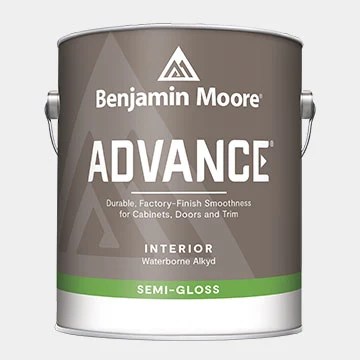
- Self-levels to a near-spray finish from a brush — closest you'll get without a sprayer
- Genuinely scrubbable; survives nightly kitchen wipe-down
- Available in BM's full color deck (3,400+ tints)
- Long recoat window (16h) — kids' hands off the doors for a full day between coats
- Full cure 30 days — skip the nightly cabinet scrub for a month
- $80–$95 / gal at BM stores; not a budget pick
| Coverage | 350–450 sq ft / gal |
|---|---|
| Sheens | Satin, semi-gloss, high-gloss |
| Dry / Recoat | Touch dry 4–6h · recoat 16h |
| Full cure | 30 days |
| VOC | 100 g/L (CARB compliant) |
| Yellowing risk | Low (waterborne alkyd) |
| Primer | Bonding primer recommended (Stix or BIN) |
| Price tier | $$$ |
2. Sherwin-Williams Emerald Urethane Trim Enamel
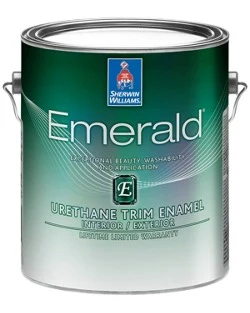
- Hardest cured film in the test — survives a marker-and-Krud-Kutter scrub better than the others
- Faster recoat (4h) than Advance — finish a project in a weekend
- Self-levels almost as well as Advance with a quality brush
- Smaller color range than Advance (Emerald deck only)
- Highest price in the test ($95–$110 / gal at SW)
- Slight ammonia smell on application — ventilation matters more than with the others
| Coverage | 350–400 sq ft / gal |
|---|---|
| Sheens | Satin, semi-gloss, gloss |
| Dry / Recoat | Touch dry 4h · recoat 4h |
| Full cure | 30 days |
| VOC | <50 g/L |
| Yellowing risk | Very low |
| Primer | Bonding primer recommended |
| Price tier | $$$$ |
3. INSL-X Cabinet Coat
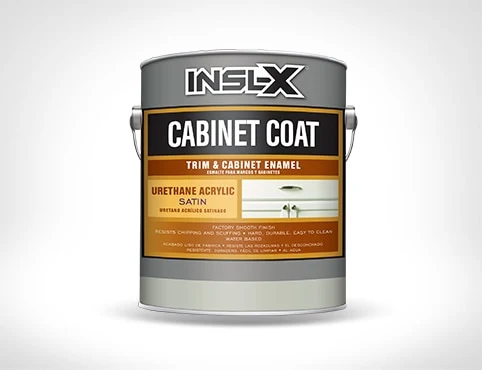
- Pro contractors keep coming back to it; 80% the finish of Advance at 50% the cost
- Brushes and rolls forgivingly — first-time refinishers can land a clean result
- Self-priming on previously-painted cabinets in good shape
- Not as dead-flat as Advance — visible brush texture if you look at 6 inches
- Limited stocking; Ace and BM stores reliable, big-box hit-or-miss
- Sheens cap at semi-gloss (no high-gloss option)
| Coverage | 350–450 sq ft / gal |
|---|---|
| Sheens | Satin, semi-gloss |
| Dry / Recoat | Touch dry 2h · recoat 16h |
| Full cure | 30 days |
| VOC | <50 g/L |
| Yellowing risk | Low |
| Primer | Self-priming on painted cabinets in good condition |
| Price tier | $$ |
4. Behr Premium Cabinet, Door & Trim Enamel
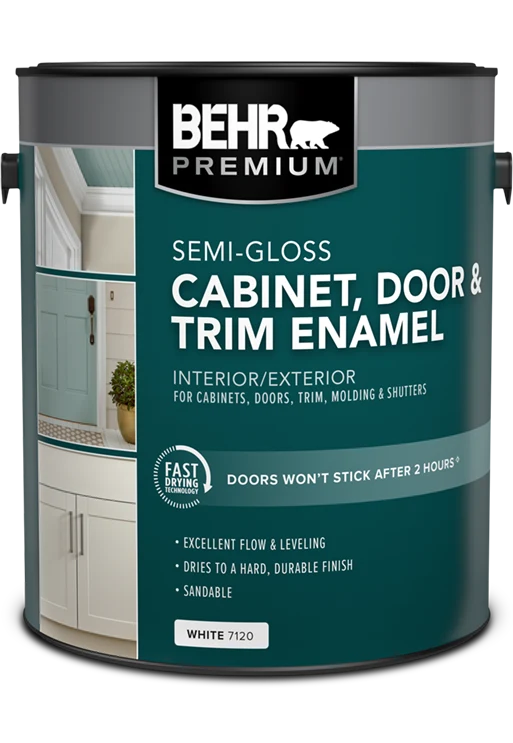
- Half the price of the BM/SW picks; readily available at any Home Depot
- Adhesion is fine on a properly prepped surface
- Decent self-leveling in semi-gloss
- Soft film for the first 60–90 days — stickier longer than Advance or Cabinet Coat
- More visible brush marks; spray it if you can
- Yellowing risk on whites in direct sun is meaningfully higher than the others
| Coverage | 300–400 sq ft / gal |
|---|---|
| Sheens | Satin, semi-gloss |
| Dry / Recoat | Touch dry 2h · recoat 4h |
| Full cure | 30 days |
| VOC | <50 g/L |
| Yellowing risk | Medium-high on white in direct light |
| Primer | Bonding primer required on glossy / laminate surfaces |
| Price tier | $ |
Insl-X Stix Waterborne Bonding Primer
Bonds to glossy, laminate, and previously-finished cabinets without sanding to bare wood. Pairs with every paint above. The single biggest fix for peeling cabinet paint: use this first.
BUY ON AMAZON