Best Paint Brushes for 2026: 5 We Actually Use
Five paint brushes tested across walls, trim, cabinets, and oil-based work. Top pick: Purdy XL Glide — and where each one falls short.

Disclosure: Some links below are affiliate links. We earn a commission if you buy through them, at no extra cost to you.
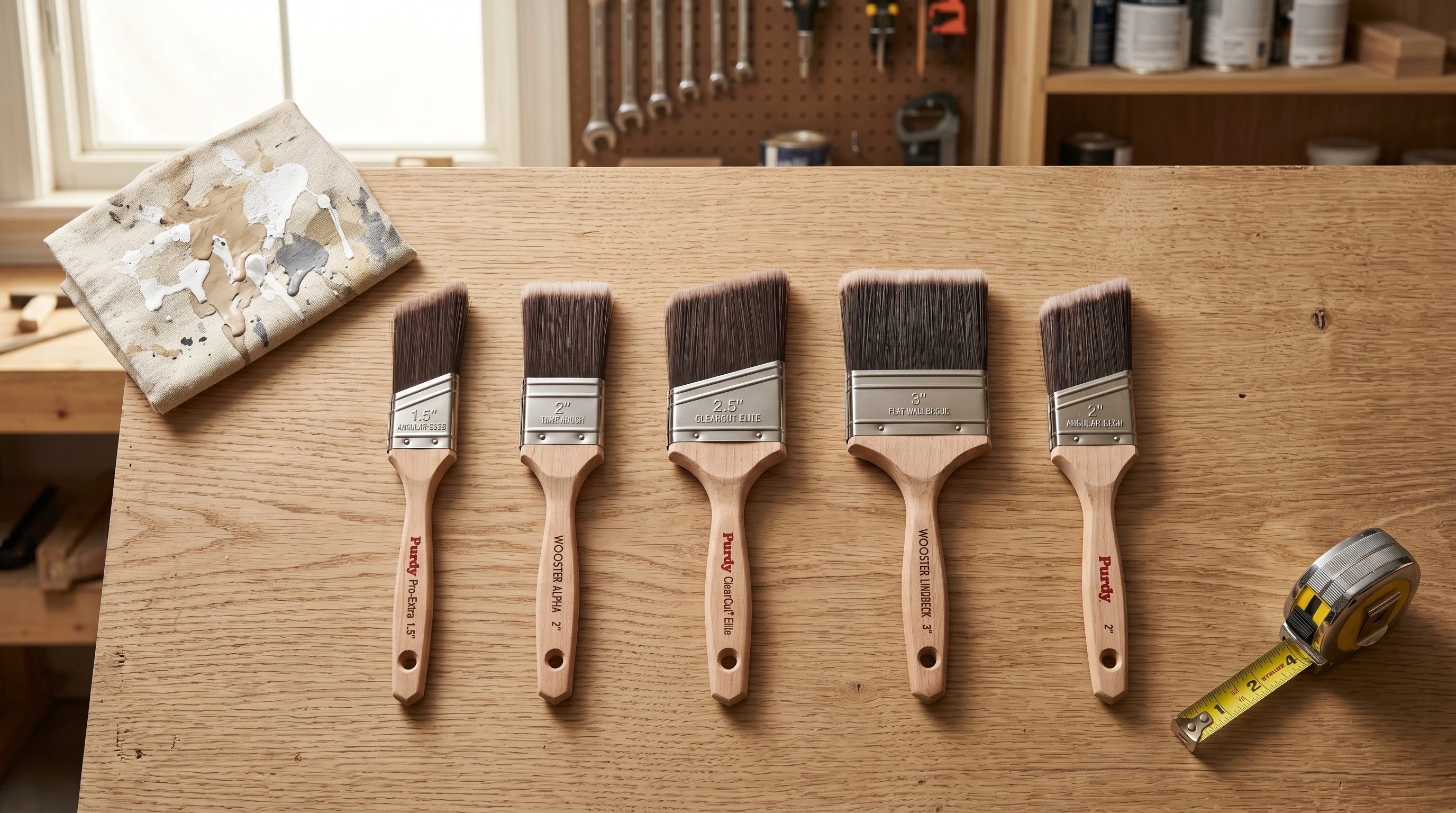
Top pick: Purdy XL Glide 2.5”. It costs about $15, holds more paint than any synthetic at its price, and lasts six years if you wash it. It wins the all-rounder fight on cut-line precision, paint load, and longevity. It falls short on finish-grade smoothness on cabinet doors, where the Wooster Silver Tip is the smarter pick. For oil-based work and varnish, neither synthetic touches the Purdy Black Bristle Adjutant. For high-volume production painting, Wooster Gold Edge pushes more paint per dip at two-thirds the price. For dead-clean cutting in, Purdy Clearcut Glide is the stiffer-tip alternative.
There is no single right brush.
Most homeowners do fine with two: the XL Glide as the everyday workhorse and the Silver Tip for the cabinet weekend.
The shortlist and why these five
We bought five brushes off the shelf, the same channels a homeowner would use, and ran them through three real projects across six weeks: a 12 x 14 ft master bedroom in Benjamin Moore Regal Select eggshell, a 28-door kitchen cabinet refinish in Benjamin Moore Advance semi-gloss, and an oil-based stain-and-varnish job on a solid pine entry door. The XL Glide and Silver Tip we already had multi-year experience with. The Gold Edge, Clearcut Glide, and Black Bristle Adjutant we ran fresh against them.
Five axes, weighted in this order: cut-line precision against tape, paint load and release per dip, self-leveling at 30 minutes under raking light, shedding in the first 60 minutes, and longevity by shape recovery after five wash cycles. Five-point scale per axis; the use case anchors the role.
We also asked four working contractors which brush they’d buy with their own money for a homeowner who paints two weekends a year. Three said XL Glide. One said Wooster Ultra/Pro Firm. None recommended anything cheaper than $12. That set our floor.
How the testing actually ran
Same protocol per project, per brush. Wall cut-ins: 50 linear feet of ceiling line, blue-taped on half, freehand on the other half, photographed under raking LED at 24 hours. Cabinet doors: ten primed MDF doors, two coats of Advance, photographed at 30 minutes wet and at 24 hours under raking light. Oil door: every brush hit the spar urethane stage. Bristle shedding counted by hand at minute 5, 20, and 60. Wash cycles: warm water plus dish soap plus paint comb for synthetics; mineral spirits twice plus soap for the natural-bristle.
We tested the brushes that show up over and over again on contractor forums, on pro paint store shelves, and in our own kits.
Picking a brush, in three decisions
Bristle: synthetic or natural
Synthetic (nylon, polyester, or a blend) for everything water-based: latex, acrylic, low-VOC, waterborne alkyd, primer. Synthetic doesn’t waterlog, holds shape, cleans up under the kitchen tap. Natural hog hair for oil-based paint, varnish, spar urethane, shellac, and lacquer. The second a natural-bristle brush touches water it goes limp, and you’ve ruined a $20 brush in two minutes. The cleanup solvent is the test: water means synthetic, mineral spirits means natural.
Within synthetic there’s a softness gradient. Soft (Silver Tip’s CT polyester) lays the flattest finish on enamel; that’s the cabinet-door brush. Medium-stiff (XL Glide’s Tynex/Orel blend) is the all-rounder. Stiff (Clearcut’s denser nylon-polyester) carves the cleanest cut lines. Most homeowners need one medium-stiff brush.
Cut, shape, and width
Angular (one corner extended, like a chisel held sideways) wins on cut-ins because the long corner reaches into corners and along ceiling lines a flat brush can’t. Flat wins on broad trim runs and exterior siding. A 2.5” angular sash covers 80% of household paint work; a 2” angular adds precision in tight spots; a 3” flat speeds up big trim runs.
Handle and ferrule
Less consequential than the bristle, but the gap between a $4 brush and a $15 brush shows up here too. Stainless steel ferrule, hardwood handle (alderwood, beech). Plastic ferrules and unfinished pine handles signal a brush that won’t last past one project.
At-a-glance comparison
| Brand / Model | Bristle | Width tested | Best paint type | Best for | Price tier |
|---|---|---|---|---|---|
| Purdy XL Glide | Tynex/Orel synthetic, medium-stiff | 2.5” angular sash | Latex, oil, primer | Everyday all-rounder | $$ |
| Wooster Silver Tip | 100% CT polyester, soft | 2.5” angular sash | Waterborne enamel | Cabinets, finish trim | $$ |
| Purdy Black Bristle Adjutant | Natural hog hair, medium-stiff | 2” flat | Oil-based, varnish | Oil paint, spar urethane | $$ |
| Wooster Gold Edge | Firm CT polyester | 2.5” angular sash | All paints | High-volume wall work | $ |
| Purdy Clearcut Glide | Nylon/polyester, stiff | 2” angular sash | Latex, low-VOC | Cut-in and sash | $$ |
1. Purdy XL Glide 2.5”, top pick
The XL Glide is the brush you reach for first and the brush you grab when you don’t want to think about which brush. Its medium-stiff Tynex/Orel blend handles whatever paint you put on it, latex flat, latex eggshell, primer, even oil if you’ve got nothing else handy, and lays it down with a clean release. Paint load is generous: dipping the bottom third and tapping (not dragging) against the bucket rim, you get three to four feet of cut-in per dip on standard latex. The angular cut holds a sharp tip through a full day of work. We’ve taken one through five gallons of wall paint without it fanning out.
Recovery after a proper wash is the part nobody talks about. Comb it out, hang handle-up, and the next morning it looks new. We have one in the kit that’s six years old and still cuts a clean line.
On cabinet doors under raking light at six inches, the XL Glide leaves slightly more visible brush stroke than a Silver Tip. Call it 95% smooth vs the Silver Tip’s 99%. At arm’s length, indistinguishable. It also sometimes loses one or two bristles in the first 20 minutes of a new brush. Pull them off the wet wall with a fingertip and move on.
| Spec | Value |
|---|---|
| Bristle | DuPont Tynex nylon + Orel polyester, medium-stiff |
| Sizes | 1.5”, 2”, 2.5”, 3”, 3.5” |
| Best for | Everyday latex, oil, primer, walls and trim |
| Approx. price | $14–$17 (2.5”) |
Buy it if: you want one brush that does almost everything well and lasts five-plus years. Skip it if: your project is finish-grade cabinet doors and budget isn’t the constraint. Pay up for the Silver Tip.
2. Wooster Silver Tip 2.5”, best for smooth finish
The Silver Tip is the softest synthetic we’ve tested, and on cabinet doors that softness pays off in finish flatness. The 100% CT polyester filament is fine enough that paint releases from the bristle in a near-uniform film instead of a stippled one. Brush stroke settles out under raking light at 30 minutes in a way the firmer brushes can’t quite match. With Benjamin Moore Advance on primed MDF, the Silver Tip gave us the closest to a sprayed finish you can get from a hand brush.
The same softness makes it the wrong brush for thick latex on rough siding or a heavily textured wall. We also see the tip flag faster on the Silver Tip than on the XL Glide: a Silver Tip starts losing crispness around job thirty, while an XL Glide is still sharp at job sixty. For cabinets and finish trim, thirty jobs is a lot of cabinets. For walls, it’s not enough.
Buy it if: you’re refinishing cabinets or trim and finish flatness matters more than longevity. About $18–$22 for the 2.5”.
3. Purdy Black Bristle Adjutant 2”, best for oil-based and varnish
Once you switch from latex to oil-based paint, varnish, or spar urethane, synthetic stops being the right tool. Natural hog hair holds two to three times the solvent-based paint per dip of the best synthetic, and the naturally flagged tips lay varnish down in a way that hides lap marks at the wet edge. On the pine door we tested, the Black Bristle Adjutant laid spar urethane at one-and-a-half coats’ thickness in a single pass; the synthetic control needed two thinner passes.
Don’t put this brush in water; natural hog hair waterlogs and goes mushy. Cleanup is slower: two solvent baths, then soap and warm water, then a comb. Oil-based formulations are getting harder to find as states tighten VOC regulations, so the use case is shrinking. For exterior trim in marine environments, varnish work, oil stains, and BIN shellac primer, nothing synthetic touches it.
Buy it if: you varnish, refinish doors with oil, or use BIN shellac regularly. About $16–$20 for the 2”.
4. Wooster Gold Edge 2.5”, best budget
The brush we hand a contractor friend who paints six bedrooms a week. Firm CT polyester, built for production. At $9–$12 it’s the cheapest brush we’d actually buy. On a bedroom in eggshell, it hit full coverage in 15% fewer dips than the Silver Tip because firm bristle releases paint on contact. Wrong tool for cabinets. Tip can hook after a year of heavy use.
Verdict: buy two, rotate, replace yearly.
5. Purdy Clearcut Glide 2”, best for cutting in
Stiffest tip in the synthetic field, and that stiffness is what cuts a clean line. Pulled along a ceiling under blue tape, the Clearcut laid the sharpest line in the test, about 5–10% sharper than the XL Glide on the same wall judged on photographed comparison shots. The bristle springs back to its angle on every dip; you don’t have to keep nudging the tip into shape the way you do with softer brushes.
It’s overkill on furniture and finish trim. The same stiffness that cuts a clean line stipples mildly on flat panel work. Pair it with a Silver Tip if you’re doing cabinets.
Buy it if: your cut lines need a tape-quality edge freehand. About $13–$16 for the 2”.
Brushes we tried and dropped
- Wooster Shortcut. Useful behind toilets and inside cabinet boxes. Specialty, not a general recommendation.
- Wooster Ultra/Pro Firm Lindbeck. Excellent contractor brush. Gold Edge wins the budget slot on price and stocking.
- Purdy Pro-Extra Glide. Sold as a heavier-duty XL Glide. We couldn’t reliably feel the difference.
- Generic chip brushes. Acceptable for cleaning, not for paint.
- Foam brushes. Fine for stain on furniture; useless on wall paint.
Care, cleanup, longevity
The brushes above last 4–6 years if you wash them, three weeks if you don’t. The cleanup routine matters more than the brand on the ferrule.
Latex on a synthetic brush. Scrape excess paint back into the can (don’t push it deeper into the heel where bristle meets ferrule). Rinse warm water from base to tip, working soap into the heel with your fingers. Most paint hides there; that’s where neglected brushes go to die. Rinse 60–90 seconds until runoff is clear. Comb straight from heel to tip with a paint comb (about $4). Hang handle-up. Never lay a wet brush flat: it dries with a permanent bend. Four minutes total.
Oil on a natural-bristle brush. Scrape, then swish vigorously in a small jar of mineral spirits for 30 seconds. Repeat in clean spirits. Brief soap and warm water. Comb and hang. Eight to ten minutes. The first jar of spirits goes in a labeled “dirty solvent” jar; paint settles to the bottom over a week and you pour the clean solvent off the top.
Between jobs on the same paint. Wrap the head in plastic wrap or foil and refrigerate (latex) or store sealed at room temp (oil). Workable overnight without a full wash. Don’t go more than 24 hours; paint sets even in the fridge.
Realistic life across 50+ jobs: XL Glide 60–80, Clearcut Glide 50–70, Black Bristle Adjutant 30–50 (oil only), Silver Tip 30–40 in finish work, Gold Edge 25–35 used hard. Replace when permanent fanning won’t comb out, or bristle loss tops about 5%.
Mistakes we still see
- A $3 brush for finish-grade trim. Savings disappear in the hour you spend fighting brush marks and the next hour sanding them out.
- Natural bristle with latex. The bristle waterlogs, the brush is ruined, the finish dimples. Don’t mix.
- Skipping the wash. A latex brush left to dry overnight is a brush you’ve thrown away.
- Loading past the heel. Dipping more than a third of the bristle pushes paint into the ferrule, where it dries hard and splays the bristles permanently. Dip the bottom third, tap the rim twice, paint.
- Dragging across the bucket rim. Wipes paint off the corner you actually need for cut-ins. Tap, both sides, twice.
- Working past the wet edge above 75°F. Latex starts setting before the brush gets back. Paint at 65–72°F.
A starter kit that earns its keep
For a homeowner doing a couple of weekend projects a year: Purdy XL Glide 2.5” ($15), Purdy Clearcut Glide 2” ($14), Wooster Silver Tip 2.5” ($20), paint comb ($4), brush sleeves ($5). About $58 total.
For a contractor’s daily kit, swap the Silver Tip for two Gold Edges and a Black Bristle Adjutant. About $50–$60 for three brushes that earn their keep on the first job.
The brushes are the cheap part. Don’t economize on the brush and waste the paint.
FAQ
Are expensive paint brushes worth it? Yes, with a ceiling. A $15 Purdy XL Glide outperforms a $4 chip brush on every measure that matters. A $25 Wooster Silver Tip outperforms the XL Glide on cabinets and trim. Above $25 you’re paying for specialty bristle for a niche use case.
Synthetic vs natural bristle? Synthetic for water-based, natural for oil-based. The cleanup solvent is the test: water means synthetic, mineral spirits means natural.
How long should a paint brush last? A well-cared-for XL Glide or Silver Tip should last 50–80 paint days. Call it 4–6 years for a homeowner, one busy season for a contractor. Replace when permanent fanning won’t comb out.
Why does my brush leave streaks? Three causes: brush too stiff for the paint (use a softer brush for enamel), working past the wet edge above 75°F, or overloading the brush. Dip the bottom third only; tap rather than drag against the rim.